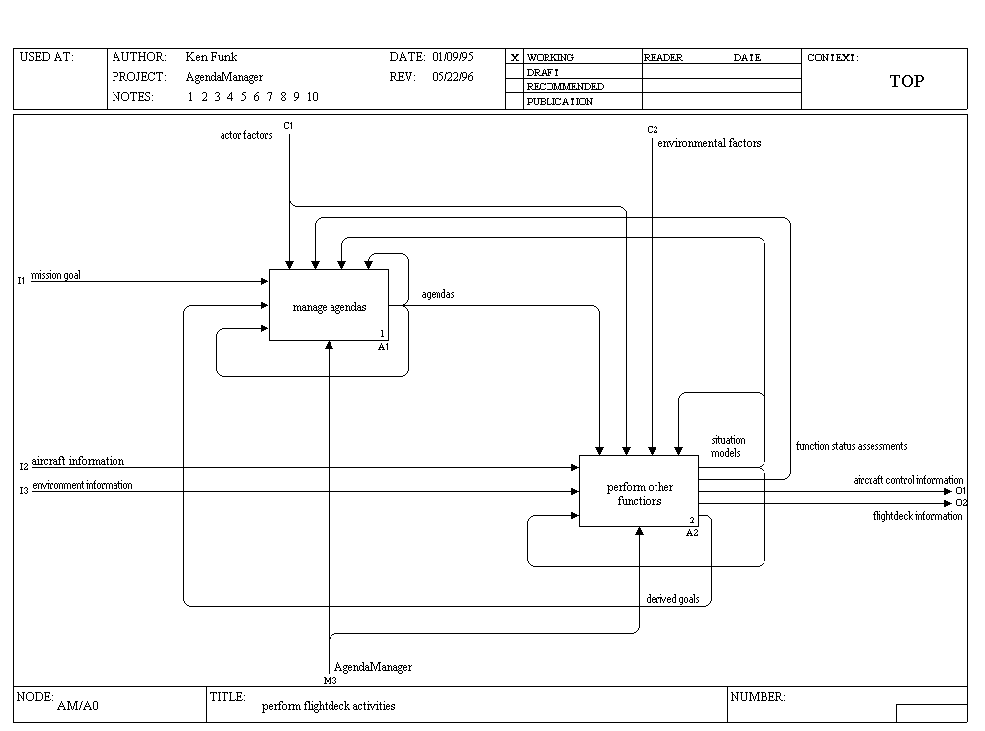
Factors (properties, attributes, characteristics) that affect actor behavior. For human actors, these include - knowledge (declarative, procedural) - inherent capabilities and limitations - memory - motivation - workload - level of alertness - fatigue - level of authority - etc. For machine actors, these include - knowledge (declarative and procedural) - functional capabilities and design limitations - operational state (operational, inoperative) - etc.
AgendaManager
A computational aid to facilitate management of the flightdeck agenda.
agendas
The agendas of the actors. Literally, an agenda is a list of things to be done. In the context of this model, an agenda consists of a set of goals to be achieved, a set of functions to accomplish them, assignments of actors to functions, and allocations of resources to functions. Each actor maintains his/her/its own agenda, which may or may not be consistent with the agendas of other actors. Together, the individual agendas can be viewed as forming a single, composite flightdeck agenda.
aircraft control information
Control information from the flightdeck to the aircraft and its subsystems.
aircraft information
Information about the state of the aircraft and its subsystems, such as altitude, fuel flow, etc.
derived goals
These are (sub)goals derived from other goals through planning, decision making, and problem solving functions.
environment information
Information from and about the environment coming to the flightdeck, including ATC queries and clearances.
environmental factors
Factors in the aircraft and flightdeck environments that affect flightdeck activities, including weather conditions, turbulence, illumination, temperature, etc.
flightdeck information
Information that passes from the flightdeck to the environment, including responses and acknowledgements to ATC, etc.
function status assessments
Assessments of function status: actor performance (speed, accuracy), progress, liklihood that the goal will be achieved, etc.
manage agendas
Manage the agendas of all actors.
mission goal
A goal is a desired system behavior and may involve attaining a desired state or maintaining a desired state. The mission goal is the high level goal to be accomplished in a commercial transport aircraft mission, that of safely, legally, and efficiently moving the aircraft and its cargo from the origin airport to the destination airport. In the course of flightdeck activities, the mission goal is decomposed into more specific subgoals.
perform other functions
Perform specific functions (other than managing agendas) to achieve the mission goal and its subgoals. These can include monitoring aircraft subsystems, changing the state of the aircraft and its subsystems by manipulating controls, decision making, problem solving, and planning, which yields additional (derived) goals to accomplish. Performing such functions involves maintaining situation models.
situation models
The actors' situation models. A situation model is an internal representation of the past, present, and (projected) future state of the the environment, the aircraft, and the flightdeck. Each actor maintains his/her/its own situation model, which may or may not be complete or accurate and may or may not be consistent with the models of other actors.